

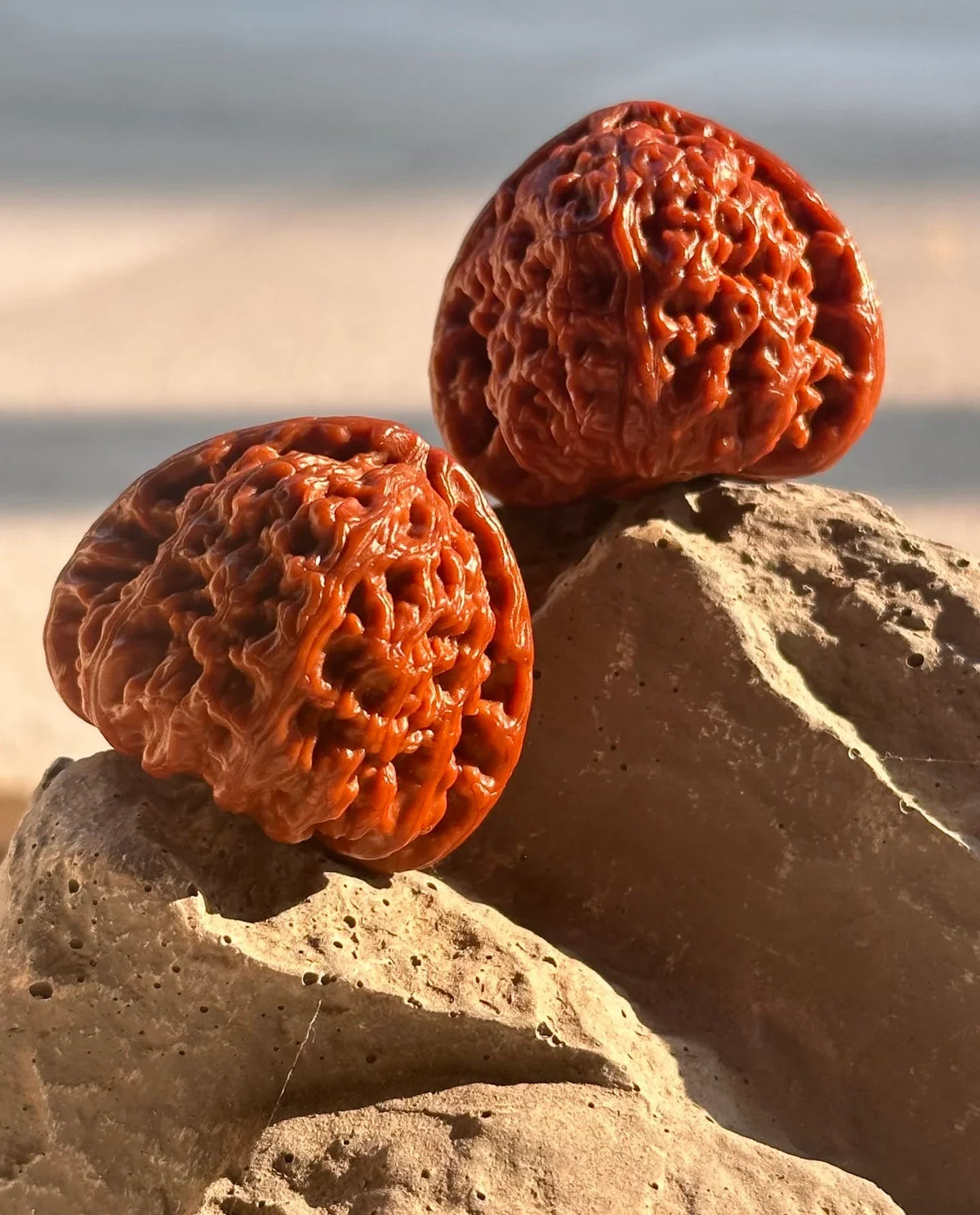
Wenwan walnuts on stone. An illustration of the practice, not a Dior campaign image.
Updated with post-show reporting on September 30, 2026.
Dior’s walnut reference now has a clear context: invitations to its Summer 2027 women’s show included a pair of wenwan walnuts. The Associated Press reported the invitation detail after the September 29, 2026 presentation in Paris. For anyone encountering these objects through fashion, the useful next question is what people do with them.
Wenwan walnuts are collected, handled and appreciated for their shells. The interest lies in their shape, texture and the surface character that develops with use. They belong to an existing Chinese practice with a vocabulary of its own, one that reaches well beyond a runway reference.
What happened at Dior?
Dior’s official page names the collection Summer 2027. The Fédération de la Haute Couture et de la Mode calendar records the presentation on September 29, 2026. Those dates describe the collection season and the event, respectively; this was not a show held in September 2027.
Reuters, in reporting by Helen Reid, describes a box containing two wenwan nuts sent with invitations. It also reports that Jonathan Anderson’s post-show press release connected the collection with the walnuts’ natural asymmetries. ELLE’s account independently describes the invitation pair and its reference to Chinese hand-rolling and patina.
The walnuts formed part of the show’s invitation and creative reference. The sources above do not establish a retail launch of Dior-branded wenwan walnuts, an official selling price, or the identity of a supplier.
What are wenwan walnuts?
In this context, wenwan walnuts are natural objects chosen for handling and collecting. Their shells carry the detail: deep channels, raised ridges, rounded or flattened outlines, and small differences that become easier to notice as you look closely. A pair offers another point of interest—how two similar objects sit together while remaining visibly individual.
This is an established collecting category. A 2017 botanical study of wenwan walnuts investigated their identities and relationships among Asian walnut species. That research predates this fashion moment by years. It is a useful reminder that the name refers to a material tradition, not a new accessory invented for social media.
Handling is central to the appeal. People move a pair within the hand, return to its texture and observe its appearance over time. Patina describes that evolving surface character. A photograph cannot establish how a particular pair was prepared, how long it was handled, or whether a finish was added. Those are questions to ask about the actual objects.
Why would walnuts make a compelling fashion reference?
The shape offers a close-up lesson in variation. From a distance, two walnuts can seem almost identical. Turn them and the ridges diverge; their outlines, grooves and proportions become distinct. That observation gives a concrete way to understand the natural asymmetry described in the Reuters report.
There is also a contrast in pace. A runway look arrives and passes within seconds, while a hand-held object can reward repeated attention. Our reading of the reference is that it invites a closer relationship with material and time. It does not require treating an ordinary daily practice as a luxury status symbol, or judging a pair only by a fashion association.
Was the TikTok walnut trend already happening?
Yes. On March 10, 2026, nss G-Club documented TikTok’s walnut-polishing trend, including content by @moon.bodhi and @thatisosydney. That coverage appeared more than six months before the Dior presentation.
An April 13 report from the South China Morning Post described a March 31 Instagram reel by @growithjessie with more than eight million views at the time of reporting. That was an Instagram figure from April, not a current TikTok count or a measurement of American buyers.
The phrase “turn walnuts into jade” is an attention-grabbing description of appearance. A walnut shell does not become the mineral jade. The appeal is the gradual development of a familiar object, with no single finish or timetable guaranteed. Dior has supplied a new reason to notice the practice; it did not start the year’s online conversation.
If the image made you curious, where should you begin?
Start with the object rather than a promised transformation. Notice whether you like pronounced ridges or a softer outline. When considering a pair, look for clear photographs, measurements and an explanation of its condition and preparation. A dramatic glossy image alone cannot tell you what will arrive or what your own handling experience will be.
Our beginner’s guide to wenwan walnuts explains the basic terms. How to Begin introduces the movement, and Care & Questions covers everyday handling. If the passage of time is what drew you in, read our essay on patina and personal objects.
Considering your own pair? Use our online buying checklist and dated price guide. Explore First Pairs for our walnut set and current availability, or ask us about choosing a pair.
Orbit Nuts is independent of Dior, with no affiliation, sponsorship or collaboration. The accompanying photograph illustrates wenwan walnuts and is not a Dior campaign image.