

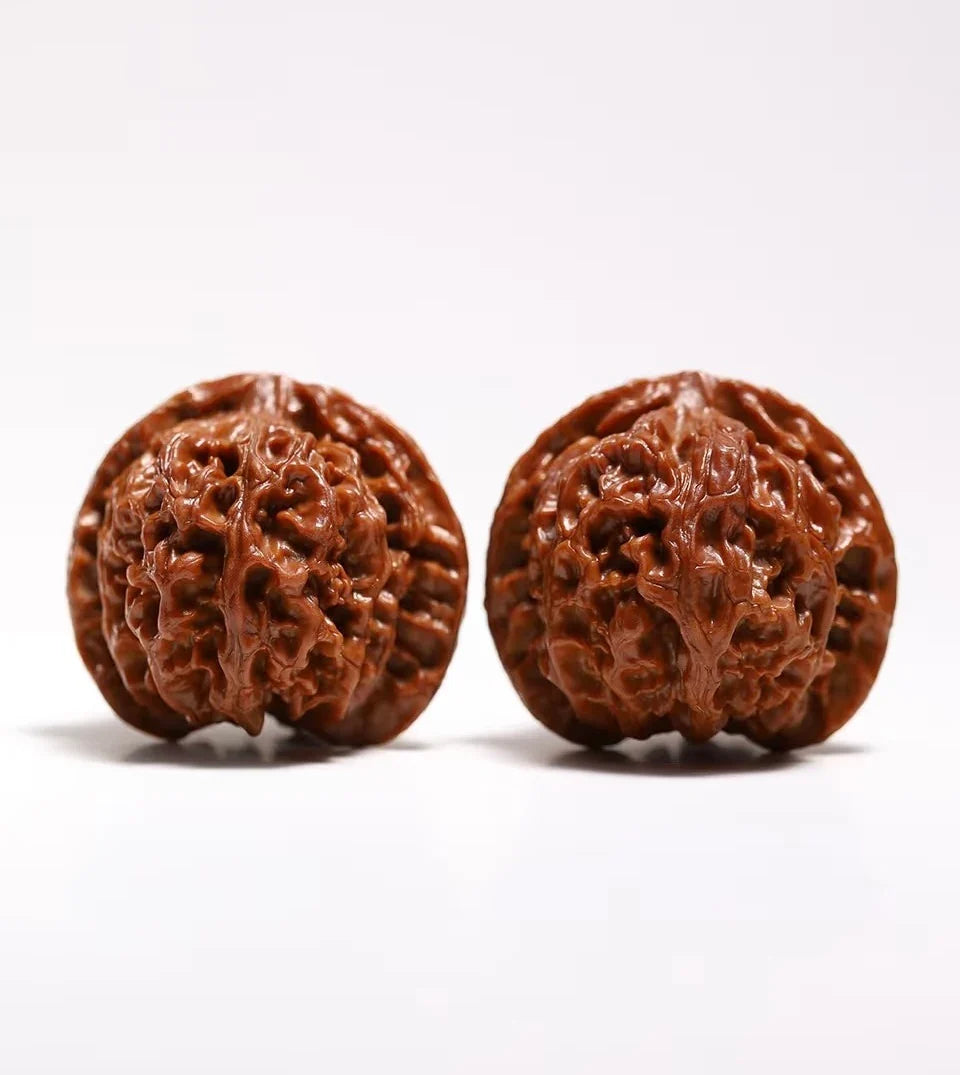
A walnut pair, seen side by side.
Wenwan walnuts are real walnuts selected for their shells and enjoyed as objects to hold, turn, and collect. Usually handled as a pair, they offer a changing landscape of ridges, grooves, and rounded edges beneath your fingers. Some people are drawn to the movement. Others enjoy choosing a well-matched pair or watching its surface develop character over time.
If you have seen a pair in a short video and wondered why someone is rolling walnuts in one hand, start here. You do not need a collector’s vocabulary or an ambitious daily routine to explore the practice.
A Chinese tradition, with room for your own routine
Wenwan walnuts belong to a Chinese tradition of appreciating and handling collectible objects. The walnut category includes different shapes, shell patterns, and named varieties. A botanical study of wenwan walnuts describes several walnut species used in this practice. That is one reason to be cautious when a seller treats every collectible walnut as the same botanical material.
The Chinese name is worth keeping as you learn. It points to a collecting practice with its own vocabulary. You can ask how a pair is described by its grower or supplier without needing to master every variety name before you begin.
Why a pair?
A pair gives your fingers two objects to move in relation to each other. You might turn them slowly in one palm, alternate their positions, or simply explore one shell at a time. There is no need to reproduce a fast movement from a video.
Matching also adds a visual dimension. Two naturally formed walnuts can echo each other in size, overall shape, and texture without being identical. Look at both pieces individually. A convincing match should still let you see the small differences that make each walnut recognizable.
Are they the same as grocery-store walnuts?
The purpose is different. Walnuts sold for eating are food products. Wenwan walnut pairs are offered for handling and collecting, with attention to their external appearance and condition. A name or attractive shell does not establish how an individual pair was cleaned, stored, or treated.
Treat a pair sold for hand-play as an object, not a snack. These are real walnuts; anyone with a walnut allergy should avoid them. Keep them away from young children and pets, and do not crack one open to investigate its suitability as food.
What does “patina” mean?
In this context, patina describes the surface character that can develop through handling and care, including changes in color and sheen. It is part of the appeal for many enthusiasts, but it is not a timed performance.
Your pair may change unevenly, subtly, or more slowly than a pair in a video. Starting condition, the individual shells, and how they are handled all matter. A photograph can also look different under warmer light. Patina is better approached as something to observe than as a promised result.
Your first few minutes
Begin with clean, dry hands and a soft surface underneath in case a walnut slips. Hold one walnut first. Notice which ridges feel pleasant and which positions feel awkward. Add the second only when the first feels comfortable.
Try a small, unhurried movement. Let your fingers guide the pair instead of gripping hard or forcing a complete rotation. Stop if the motion or texture is uncomfortable. Our How to Begin guide explains a simple starting sequence.
What to check before buying
- Measurements: ask for dimensions in millimeters, with the measurement direction explained.
- Condition: look for clear views of both walnuts, including their bases and seams.
- Treatment: ask whether oils, dyes, coatings, or other finishes have been applied.
- The purchase: confirm whether photographs show your exact pair or an example.
Our size guide explains how to read measurements and in-hand photographs. For a comparison with other tactile objects, read wenwan walnuts as a natural fidget toy.
Explore First Pairs when you are ready, and keep the care guide nearby. The point is to get acquainted with the pair in your hands. The routine can grow from there.
Find your next step
You may also see the name wenwan hetao (文玩核桃); hetao is the Chinese word for walnuts. If you want to try the movement with something you already have, read our guide to ordinary walnuts. For a selected pair, compare the price examples and use the online buying checklist.