

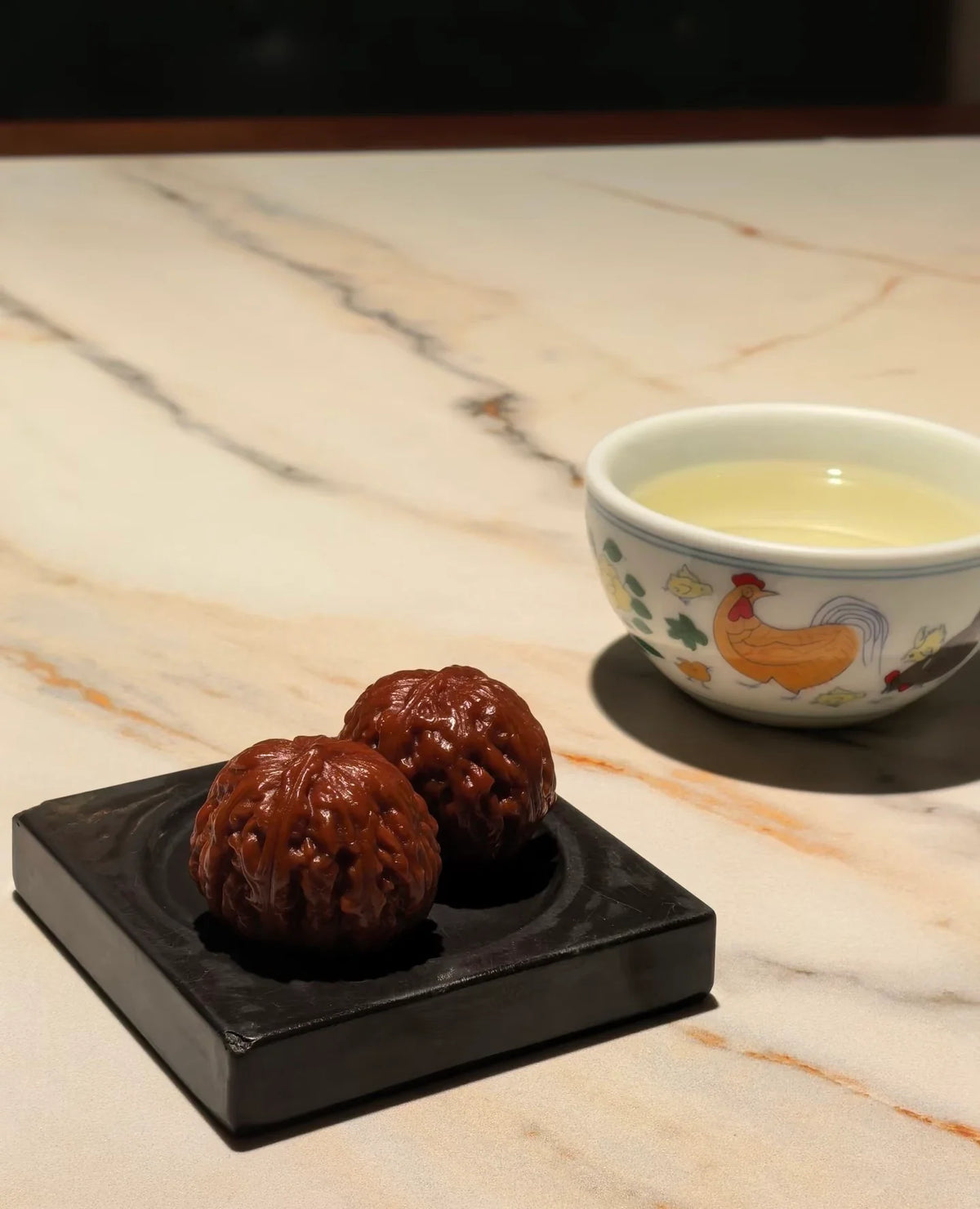
A walnut pair beside a cup of tea.
Think of a notebook softened at its corners, a wooden handle made familiar by use, or a jacket you recognize by its folds. Their surfaces can become part of how you remember them. A pair of wenwan walnuts invites a similarly personal relationship, concentrated into two small objects that fit in your hand.
The appeal need not begin with a dramatic transformation. It can begin with a particular ridge, the balance of a pair, or the simple fact that you want to pick them up again. That is the perspective we take at Orbit Nuts: familiarity is worth noticing, even when the change is too subtle for a photograph.
A surface has more than one story
Patina is a useful word, but it should not be treated as a single process shared by every material. The Smithsonian American Art Museum’s account of Eric Fischl’s Tumbling Woman II, for example, describes a bronze sculpture with an intentionally applied patina that makes it resemble aging iron. In that case, the surface effect was part of the artist’s intended finish.
For a walnut collector, the questions are different. What was the shell like at the start? Was it polished, colored, or coated? Has it already been handled? Those questions do not rank every possible finish from good to bad. They help you understand what you are looking at, and whether its history matches the experience you want.
If your interest is in watching a pair change through your own use, knowing the starting condition matters. A glossy photograph cannot supply that history on its own. An honest description is more useful than an unexplained claim that a pair has an exceptional patina.
Begin with the object, not the promised result
Wenwan walnuts reward a close look before any discussion of aging. A 2017 botanical study illustrates different walnut forms found in the collecting market. The objects have natural differences to begin with. It makes little sense to expect every pair to follow an identical visual path.
Try describing your pair without using the word “better.” Is its shape rounded or broad? Where are the deepest grooves? Which parts feel pronounced against your fingers? Does one walnut turn more easily than the other? This small exercise gives you something concrete to notice, rather than making a future red color or bright shine the only measure of enjoyment.
Familiarity is part of the experience
There is a difference between recognizing an object and knowing it through use. A familiar pair might have one ridge you can find without looking, or a position that has become easy to settle into. That knowledge belongs to the relationship between your hands and the objects. It does not need to be visible to someone scrolling through a photograph.
This is also a useful way to think about a gift. You can give someone a pair, explain what is known about it, and leave room for their own routine. You cannot give them a completed personal history with the object. Part of the appeal is that the next chapter remains theirs to make.
If you want a record, our 100-day journal guide offers a practical format. The record can include comfort and familiarity alongside appearance. It need not become a public performance or a competition for the most dramatic result.
Personal meaning includes where the object comes from
There are people and places behind these shells. A 2024 study of walnut cultivation in Beijing examined heritage conservation alongside farmers’ livelihoods. Its fieldwork included interviews in two villages within the local walnut-growing area. The practice has an agricultural setting as well as a collecting audience.
For us, that context is a reason to keep the Chinese name wenwan in view and to ask specific questions about sourcing. It is also a reason to separate a documented origin from a romantic story. Respect can be expressed through accurate names and useful information, without inventing a lineage for a product.
Choose what you want to keep
A walnut pair can be an ordinary companion to a quiet part of the day. It does not need to become a performance of discipline. If you enjoy the movement, texture, and attention involved, there is already something there to value.
We think the most interesting personal objects leave room for their owner. With wenwan walnuts, that can mean learning a movement, noticing a surface, and returning to the same pair without demanding a result on schedule. A little time, in your hands.
If you want to explore the idea with a pair of your own, First Pairs is a place to start.
Do walnuts turn into jade?
No. A walnut shell remains a walnut shell; handling does not turn it into the mineral jade. In social posts, “jade walnuts” usually describes a polished, lustrous appearance. That visual shorthand should not be treated as a material description or an outcome every pair will reach.
How long does walnut patina take?
There is no reliable universal deadline for a red color or a glossy finish. The starting shell, disclosed preparation, handling and photography all affect what you see. Record the same pair under comparable light and note anything applied to it. Avoid judging your progress against an unexplained before-and-after image.
Before choosing a pair for your own record, ask about its starting condition with our buying checklist. For a gentle way to handle it, see the rolling guide.