

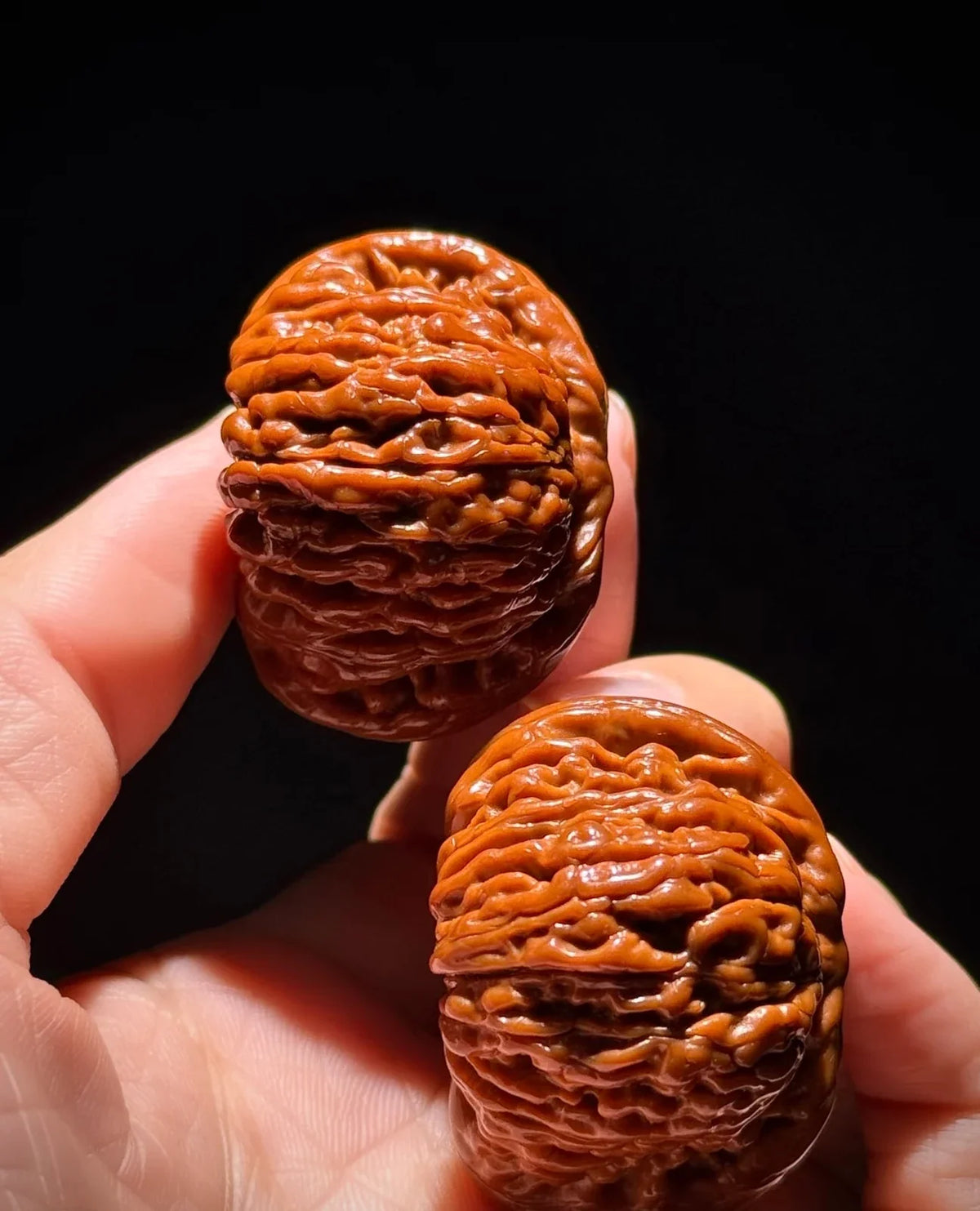
A close view of two amber-brown walnuts held in a hand.
Begin with a loosely cupped hand and a slow exchange of positions. One walnut moves toward your fingers while the other returns toward the heel of your palm. You can stop, reposition and start again as often as you need. A continuous circle is something to explore, not a test you must pass.
Beginners ask this very directly. In one getting-started discussion, a reader wanted to know what to actually do with the walnuts and whether to use one hand. The sequence below is our practical suggestion for a first attempt; it is not a prescribed training routine.
1. Give yourself a forgiving place to start
Sit at a table with a folded towel beneath your hand, or rest your forearm over a soft surface on your lap. Keep your hand low enough that a slipping walnut has only a short distance to fall. Move away from a tile floor or the edge of a desk.
Start with clean, dry hands. Put the brush and other accessories aside while you learn the movement. If rings keep catching the shells or adding unwanted clicks, removing them for this practice is an option.
2. Explore one walnut first
Place one shell in your open palm. Gently turn it with your thumb and fingertips, noticing the broad sides, ridges and tip. Let your fingers bend naturally rather than holding the shell at arm's length between rigid fingertips.
Try moving it toward the base of your fingers and back toward your palm. This helps you find a comfortable route before there is a second object to manage. If a pointed area presses unpleasantly, turn it to another orientation or stop.
3. Add the second and pause
Let both shells rest in the shallow cup of your palm. Place one a little closer to your fingers and the other nearer the heel of your hand. Your fingertips can form a loose boundary, with room for the objects to move.
Before trying a circle, simply hold this position. Can you keep both supported without squeezing? Can your fingers make small adjustments? If the pair crowds your hand, practise with one shell while you reassess the fit using our size guide.
4. Guide an exchange, then reset
Use your thumb to nudge the nearer shell toward your fingers. Let your curled fingers guide the other shell back along the opposite side of your palm. Think of two objects taking turns through the available space, rather than both spinning independently in place.
Stop after a partial turn if that is all you can comfortably manage. Use your other hand to reposition the pair, then repeat. Either direction is fine for a first attempt. Choose the one that feels less awkward before exploring the reverse.
As the exchange becomes easier, join two partial turns together. Keep the movement small and slow. There is no need to increase speed, tighten your grip or meet a daily repetition target.
5. Troubleshoot what you notice
- One keeps escaping. Lower your hand, reduce the size of the movement and reset more often. Try one walnut again. Repeated slipping can be a reason to reassess fit, not simply to grip harder.
- They jam together. Pause and reposition. Change the starting orientation or leave more room between your fingers. Do not force one shell past the other.
- They clack loudly. Slow the exchange and reduce how far they travel before meeting. In a quiet shared space, turn one walnut at a time or put the pair away.
- Your hand becomes uncomfortable. Stop and rest. Discomfort is not a milestone, and you do not need to push through it to enjoy the object.
Do the walnuts have to stay apart?
No perfect separation is required for this beginner practice. Light contact may happen while you learn. Avoid deliberately striking or grinding the shells hard together.
Collectors often use wenpan for a gentle style with little or no contact and wupan for a style allowing more contact. You will see different explanations and preferences. A first-pair rolling thread shows how common this question is. Neither label establishes a guaranteed color or patina schedule.
Sound is also a social consideration: the discussion about using walnuts in public includes people adjusting their habits to their surroundings. A quieter attempt is a useful option, not a promise that two shells will be silent.
Finish whenever you have had enough. Set the pair down carefully and follow our simple care guide when it needs attention. For a broader introduction, visit How to begin; for Orbit Nuts's walnut set and current availability, visit First pairs.